+91 97734 41022 sales@exoticalloy.com
DIN 7643 · Through-bored · Vented · To drawing

Hollow Hex Bolts Manufacturer in India

Hex bolts with an axial bore: fully through-bored hollow bolts, DIN 7643 banjo bolts with cross holes, vented screws for vacuum and feed-through bolts for wires, sensors and lubricant. Made from M6 to M48 in stainless steel, brass, duplex, nickel alloys and titanium. Every bore is deburred, cleaned and inspected before dispatch.

Request a Quote WhatsApp Sales
  • ISO 9001:2015 certified manufacturer
  • EN 10204 3.1 / 3.2 test certificates
  • Burr-free bores and cross holes
  • Strength calculated for every bore
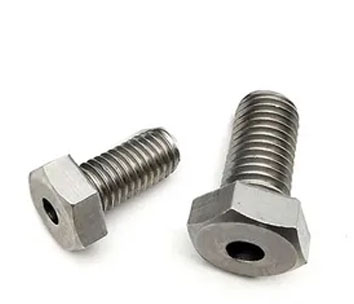
Two stainless steel hollow hex bolts showing the axial bore through the hexagon head
Size M6 – M48 · ¼″ – 2″ Bore through or blind Banjo DIN 7643 M8 – M45
Overview

DIN 7643 Hollow Banjo Bolts & Through-Bored Hex Bolts: Manufacturer & Stockist

A hollow hex bolt is a hex head bolt with a hole drilled along its axis. Outside, it fits and tightens like any hex bolt. Inside, the bore carries something the joint needs: fluid to a port, trapped gas out of a blind hole, a wire or thermocouple through a wall, or grease to a bearing.

Exotic Alloy machines hollow hex bolts in Mumbai, India, from certified hexagon and round bar. The range covers fully through-bored bolts, DIN 7643 hollow screws (banjo bolts) for DIN 7642 ring fittings, vented hex screws for vacuum, and lubrication-feed and cable feed-through bolts. The bore is drilled, deep-hole drilled or gun drilled to suit its length. Every cross hole is deburred where it breaks into the bore. We stock and supply across India and export to Qatar, the UAE, Saudi Arabia, Oman, Europe and the Americas.

As per Drawing, with Quick Delivery in Stainless, Brass & Exotic Alloys

Hollow bolts are rarely identical from one application to the next, so we make them to your drawing. You set the thread and pitch, hexagon, length, bore, cross holes, material and finish. DIN 7643 banjo bolts in free-cutting steel and CW710R brass follow the standard exactly. Stainless, duplex, Inconel, Monel, Hastelloy and titanium versions are typically turned around in 7 to 15 business days.

M6 – M48 | ¼″ – 2″ Through or blind bore 2, 3 or 4 cross holes Deep-hole & gun drilling Burr-free, cleaned bores
Hollow hex bolt at a glance
Head
Hexagon to ISO 4017 / DIN 933, DIN 7643, or to drawing
Bore
Axial, through or blind; cross holes for banjo designs
Thread
Metric coarse or fine (M10×1, M12×1.5 …), UNC / UNF, BSP on request
Standard
DIN 7643 for banjo bolts; others to drawing
Mates with
DIN 7642 ring fittings, DIN 7603 sealing rings, vented washers
Key limit
The bore reduces the stress area, so we calculate the strength of every design
Half-section of a through-bored hollow hex bolt showing the axial bore d i, thread diameter d, minor diameter d3, wall thickness at the thread root, head height k, across flats s and length L L – length under head k s d dᵢ (bore) t = (d₃ − dᵢ)/2 hex head outside view section wall at the thread root carries the load EXOTIC ALLOY
The wall carries the load. The upper half is the outside view and the lower half the section. The tensile load passes through the ring of metal between the bore di and the thread minor diameter d3. That ring sets the strength, and it is why the bore size is the first number we check on any hollow bolt drawing.
Specification

Hollow Hex Bolt Specification

The range we machine. DIN 7643 banjo bolts follow the standard; everything else is made to your drawing.

StandardsDIN 7643:2005 (hollow screws for ring-type banjos); DIN 7642 ring fittings; DIN 7603 sealing rings; DIN 3859-1 delivery conditions. Through-bored and vented bolts: hex head to ISO 4017 / DIN 933, ISO 4014 / DIN 931 or ASME B18.2.1, bore to drawing
Size rangeThrough-bored M6 to M48 and ¼″ to 2″; DIN 7643 M8 × 1 to M45 × 1.5 (pipe OD 4 to 42 mm). Lengths from 10 mm; bores up to about 25 diameters deep by gun drilling
BoreAxial through bore or blind bore; diameter to drawing, normally no more than about half the thread minor diameter; 2, 3 or 4 cross holes for banjo designs; counterbore or tapped head (e.g. for a DIN 71412 grease nipple) on request
ThreadISO metric coarse and fine (M8×1, M10×1, M12×1.5 … M45×1.5), UNC / UNF, BSP parallel on request; cut or rolled depending on wall thickness; tolerance 6g / 2A
TypesThrough-bored hollow hex bolt, DIN 7643 banjo bolt (short or long “S” thread, 3 or 4 holes), double banjo bolt, vented hex screw, lubrication-feed bolt, cable / sensor feed-through bolt
Materials11SMnPb30+C free-cutting steel (DIN 7643 regular); CuZn35Ni3Mn2AlPb CW710R and free-cutting brass; 8.8 / 10.9-class alloy steel; stainless 304 / 316 / 316L / 321; duplex 2205; Inconel 625 / 718; Monel 400; Hastelloy C-276; titanium Gr. 2 / Gr. 5
FinishFe/Zn8c 2C zinc to ISO 4042 (DIN 7643 regular for steel); other ISO 4042 finishes by agreement; electroless nickel (coats the bore); passivated stainless; vacuum-cleaned and bagged for UHV use
CertificationEN 10204 3.1 material certificate with heat number; 3.2 by TUV, DNV, Lloyd's, BV or SGS; PMI; dimensional report including bore diameter, concentricity and cross-hole position
Designation (DIN 7643)By pipe OD, then options: Hollow screw DIN 7643 – 10 (10 mm pipe, 4 holes, short thread, regular material and finish); Hollow screw DIN 7643 – 18 – 3 – S – CuZn35Ni3Mn2AlPb – F2J
PackingBores capped or bagged to keep them clean; VCI for steel; double-bagged in clean-room film for vacuum screws; labelled with drawing number, material, heat and quantity
Types

Types of Hollow Hex Bolts We Manufacture

The hex head is the same; the bore decides the job. Pick the type by what has to pass through the bolt.

Through-Bored Hollow Hex Bolts

ISO 4017 / DIN 933 head · bore to drawing

The bore runs from the head face to the thread end, so the bolt is open at both ends. Used to pass gas, fluid, a wire, an optical fibre or a thermocouple through a clamped joint, and to save weight in titanium and alloy steel bolts.

Banjo Bolts (DIN 7643 Hollow Screws)

DIN 7643 · DIN 7642 ring fitting · DIN 7603 seals

The bore starts at the thread end and stops inside the shank, where 4 cross holes (2 or 3 on the smallest size) open into the annulus of a ring fitting. Used on fuel, oil, hydraulic and brake lines, where the pipe leaves the port at an angle that can be set freely.

Vented Hex Screws for Vacuum

DIN 933 / ISO 4017 head · small axial vent bore

A small axial bore lets the gas trapped under a screw in a blind tapped hole escape during pump-down. That removes a common “virtual leak” in high and ultra-high vacuum chambers. Supplied in 304, 316 or titanium, cleaned and bagged for vacuum.

Lubrication-Feed Bolts

Head tapped for DIN 71412 grease nipple · cross hole to drawing

The bore carries grease or oil from a nipple in the head to a cross hole at the bearing, pin or bush the bolt passes through. Common on pivot pins, linkages and conveyor rollers.

Cable & Sensor Feed-Through Bolts

Through bore, deburred and radiused at both ends

A smooth, radiused bore takes a cable, a thermocouple sheath or a capillary through a panel, housing or flange while the bolt holds the parts together. Potting or a gland can be added at the head.

Double Banjo & Special Banjo Bolts

Two sets of cross holes · inch UNF and BSP versions

A longer shank with two sets of cross holes lets two ring fittings be stacked on one port. Inch (UNF) and BSP banjo bolts for imported equipment are made to drawing.

Left: section of a banjo joint with a DIN 7643 hollow screw, two DIN 7603 sealing rings and a DIN 7642 ring fitting, showing the fluid path from the pipe through the annulus and cross holes into the bore and the port. Right: a vented screw in a blind tapped hole letting trapped gas escape through its bore. Banjo joint: DIN 7643 hollow screw Vented screw in a blind hole port (pump, valve, filter) pipe hollow screw, DIN 7643 sealing ring, DIN 7603 ring fitting, DIN 7642 sealing ring, DIN 7603 cross holes → bore → port chamber wall / blind tapped hole trapped gas escapes through the vent bore vented hex screw EXOTIC ALLOY
Two hollow bolts, two jobs. In the banjo joint the bolt is part of the fluid path: fluid enters the ring fitting from the pipe, passes through the cross holes into the bore and out into the port. One sealing ring sits under the head and one under the ring fitting. In the vacuum chamber the vent bore lets the gas sealed under the screw escape, so it does not leak back slowly during pump-down.

Which hollow bolt? Types compared

TypeBoreCross holesStandardSealingTypical sizesMain use
Through-bored hollow boltHead to tip, open both endsNoneHead to ISO 4017 / DIN 933; bore to drawingNot required, or gland / pottingM6 – M48Pass-through, weight saving
Banjo boltBlind, from thread end4 (2 or 3 on M8×1)DIN 7643Two DIN 7603 ringsM8×1 – M45×1.5Fuel, oil, hydraulic, brake lines
Vented screwSmall, head to tipNoneHead to DIN 933 / ISO 4017; vent to drawingNone (vacuum side)M3 – M12 typicalHigh and UHV vacuum
Lubrication-feed boltFrom tapped head to cross hole1 or 2 at the bearingGrease nipple DIN 71412; bolt to drawingNipple threadM10 – M30Pins, pivots, linkages
Feed-through boltHead to tip, radiusedNoneTo drawingGland or pottingM8 – M48Cables, thermocouples, capillaries
Dimensions

Hollow Hex Bolt Dimensions: DIN 7643 & Through-Bored Sizes

The banjo bolt table is transcribed from DIN 7643:2005-07, Table 1. The through-bored table gives example bores for each coarse size and the stress area left after each, so a drawing can start from a sensible bore.

Pipe OD
mm
Thread d1s
across flats
m
head height
l13
length, short ±0.2
c1
thread, short min
l14
length, long (S) ±0.2
c2
thread, long min
d30
axial bore H14
d27
cross hole, 4-hole H14
d28
cross hole, 3-hole H14
d29
shank h12
r5
underhead radius
4 and 5M8 × 1125178.5——4—380.2
6M10 × 1146198.52312.55.52.83.5100.2
8M12 × 1.51762411281573.54.5120.2
10M14 × 1.51962611321794.55.5140.2
12M16 × 1.522628113619115.57160.2
15M18 × 1.5246321142211378.5180.2
18M22 × 1.52773913502416911220.4
22M26 × 1.532745136028201113.5260.4
28M30 × 1.536751136830241316300.4
35M38 × 1.54686115——321620380.6
42M45 × 1.55596915——392024450.6

All dimensions in mm. Sizes are named by pipe outside diameter. The short thread version is the default; the long version is ordered with “S” and is not made for M8, M38 or M45. From 6 mm pipe the standard design has 4 cross holes of diameter d27; 3 holes of d28 are supplied by agreement. The 4 mm and 5 mm size has 2 or 3 holes at the maker's choice. The standard also requires that the thread run-out must not reach the cross hole.

SizePitch
mm
d3 minor dia.
mm
As solid
mm²
Small bore
≈ 0.3 d3, mm
As
mm²
RetainedLarge bore
≈ 0.5 d3, mm
As
mm²
RetainedWall at root, large bore
mm
M614.7720.1119.396 %217.084 %1.39
M81.256.4736.61.534.895 %329.581 %1.73
M101.58.1658.0254.895 %445.478 %2.08
M121.759.8584.32.579.494 %4.568.481 %2.68
M14211.55115.43108.494 %5.591.779 %3.02
M16213.55156.74144.192 %6.5123.579 %3.52
M182.514.93192.54179.993 %7154.080 %3.97
M202.516.93244.85225.292 %8194.579 %4.47
M222.518.93303.45.5279.692 %9239.879 %4.97
M24320.32352.56324.292 %10274.078 %5.16
M27323.32459.46.5426.293 %11.5355.577 %5.91
M303.525.71560.67.5516.492 %12.5437.978 %6.60
M333.528.71693.68.5636.892 %14539.678 %7.35
M36431.09816.79753.192 %15.5628.077 %7.80
M39434.09975.810897.292 %17748.877 %8.55
M424.536.481120.910.51034.392 %18866.477 %9.24
M454.539.481306.011.51202.192 %19.51007.477 %9.99
M48541.871473.112.51350.492 %20.51143.178 %10.68

Calculated from ISO thread geometry: d3 = d − 1.2269 P and As = π/4 · ((d2 + d3)/2)². The hollow stress area is As − π/4 · di². Bores are rounded down to the nearest 0.5 mm. The hex head and length follow ISO 4017 / DIN 933 unless the drawing says otherwise; see the hex bolt dimension table.

DIN 7643 hollow screw: half-section with across flats s, head height m, length l13, thread length c1, axial bore d30, cross holes d27 and shank d29, and end views of the 4-hole and 3-hole designs m l₁₃ (short) / l₁₄ (long, S) c₁ / c₂ thread d₃₀ bore d₂₇ cross hole s d₂₉ 4 holes (standard, ≥ 6 mm pipe) 3 holes (by agreement) EXOTIC ALLOY
Reading the DIN 7643 table. s is the hexagon across flats and m the head height. l13 / l14 are the short and long lengths and c1 / c2 the minimum thread lengths. d30 is the axial bore, d27 / d28 the cross holes for 4-hole and 3-hole designs, d29 the shank and r5 the underhead radius. Schematic, not to scale.
Strength

Hollow Bolt Strength: What the Bore Costs

This is the most important section for anyone specifying a hollow bolt. A bore removes metal from the one place that carries the load, the threaded stress area. The figures below are calculated from thread geometry, not estimated.

Share of the solid-bolt threaded stress area retained by each DIN 7643 hollow screw after its axial bore d30 is removed DIN 7643: threaded stress area retained after the axial bore (computed) 0 % 25 % 50 % 75 % 100 % M8×1 68 % M10×1 63 % M12×1.5 56 % M14×1.5 49 % M16×1.5 43 % M18×1.5 39 % M22×1.5 40 % M26×1.5 34 % M30×1.5 30 % M38×1.5 24 % M45×1.5 20 % EXOTIC ALLOY
Banjo bolts are fluid fittings, not structural fasteners. DIN 7643 sizes the bore for flow. An M8×1 banjo bolt keeps about two thirds of the solid threaded area, but the M45×1.5 size keeps one fifth. Tighten banjo bolts to the torque the sealing ring needs, never to the torque of a solid bolt with the same thread.

DIN 7643 banjo bolts: threaded section left after the bore

ThreadAs solid
mm²
Axial bore d30
mm
As with bore
mm²
Threaded section retainedWall at thread root
(d3 − d30) / 2, mm
Bore flow area
mm²
M8 × 139.2426.6 68 %1.3912.6
M10 × 164.55.540.7 63 %1.6423.8
M12 × 1.588.1749.6 56 %1.5838.5
M14 × 1.5124.5960.9 49 %1.5863.6
M16 × 1.5167.21172.2 43 %1.5895.0
M18 × 1.5216.21383.5 39 %1.58132.7
M22 × 1.5333.116132.0 40 %2.08201.1
M26 × 1.5475.020160.9 34 %2.08314.2
M30 × 1.5642.124189.7 30 %2.08452.4
M38 × 1.51051.732247.4 24 %2.08804.2
M45 × 1.51492.539297.9 20 %2.081194.6

Stress areas are for the fine threads of DIN 7643 and the d30 bore of Table 1. The cross holes reduce the section again locally in the plain shank, so the shank and the thread are both checked on special designs.

Bore ≈ 0.3 × d3≈ 92 %of the solid stress area kept: vents, wires, weight saving
Bore ≈ 0.5 × d3≈ 78 %kept: our usual upper limit for load-carrying hollow bolts
DIN 7643 bores20 – 68 %kept: flow first, so tighten to the seal, not the thread

Property classes and hollow bolts

ISO 898-1 and ISO 3506-1 give proof loads and breaking loads for solid bolts, calculated on the full stress area. A hollow bolt made from class 8.8 or A4-80 material has the strength of that material, but only over a smaller area, so it cannot honestly be marked or certified as an 8.8 or A4-80 bolt on load.

We certify the material to EN 10204 3.1 and state the property class of the material. Where a load rating matters we calculate the reduced stress area, as in the tables above and the calculator below. On request we pull finished hollow bolts to failure and report the actual load.

Material strength used for hollow hex bolts

Material / classStandardRm min
MPa
Rp0.2 min
MPa
Typical use in hollow bolts
11SMnPb30+C (1.0718)DIN EN 10277-3size-dependent, per EN 10277-3—DIN 7643 regular material: free-cutting steel for banjo bolts, zinc plated
CuZn35Ni3Mn2AlPb (CW710R)DIN 3859-1per supply condition—DIN 7643 alternative material: high-tensile brass banjo bolts for fuel, oil and marine lines
Steel, class 8.8 materialISO 898-1 (material values)800 (≤ M16) / 830640 / 660Hydraulic and machine hollow bolts; certified as material, not as a solid-bolt proof load
Steel, class 10.9 materialISO 898-1 (material values)1040940High-load banjo and feed-through bolts where the bore is small
Stainless A2-70 (304)ISO 3506-1 (material values)700450Vented vacuum screws, food and water lines, general corrosion
Stainless A4-70 / A4-80 (316)ISO 3506-1 (material values)700 / 800450 / 600Chloride service, marine, chemical and semiconductor vacuum
Materials

Hollow Hex Bolt Materials & Alloy Grades

The fluid or atmosphere in the bore usually decides the material, because the inside of a small bore cannot be coated reliably. Every grade below links to its datasheet on this site.

Austenitic 304 / 316
ISO 3506 A2 / A4 material · vacuum and fluid service

The standard choice for vented vacuum screws, water, food and chemical lines. 316L where the bolt is welded or the fluid carries chlorides, 321 for hot gas.

Free-machining & special stainless
303 · 904L · Nitronic 60 · A-286

303 machines best for long bores in non-critical service; 904L for acids; Nitronic 60 where the bolt must not gall; A-286 for hot sections.

Free-cutting steel
11SMnPb30+C (1.0718), DIN 7643 regular material

Cold-drawn leaded free-cutting steel to EN 10277-3. It drills and cross-drills cleanly at speed, which is why DIN 7643 makes it the default. Zinc plated for hydraulic and fuel lines.

Alloy steel, 8.8 / 10.9-class material
4140 / 4340, quenched and tempered

For hollow bolts that must carry load, such as feed-through bolts in machine frames and lightweight bolts, with the reduced stress area calculated.

High-tensile & free-cutting brass
CuZn35Ni3Mn2AlPb (CW710R), DIN 7643 alternative · C36000

Brass banjo bolts suit fuel, lubricating oil, compressed air and marine fresh-water lines. They need no coating inside the bore and machine to a smooth finish.

Bronzes & copper
Aluminium bronze · NAB · silicon bronze · copper

For seawater lines, non-sparking service and electrical feed-throughs where conductivity matters.

Inconel
N06625 · N07718

Hot gas, turbine and exhaust feed-throughs; seawater and sour fluids.

Monel & Hastelloy
N04400 · N10276

Seawater and hydrofluoric acid (400); wet chlorine and hot acids (C-276).

Duplex
S32205 · S32750

Chloride service with higher strength than 316, useful when a bore takes area away.

Titanium
R50400 · R56400

Grade 5 hollow bolts for motorsport and aerospace weight saving; Grade 2 for chlorine and vacuum.

Exotic alloy hollow bolts: minimum properties of the bar we machine from

AlloyUNSCondition suppliedTensile min
MPa
Yield 0.2 % min
MPa
Elongation
%
Why it is chosen for hex bolts
Inconel 625N06625Solution annealed (Grade 1)82741430Seawater, sour gas, cryogenic to 980 °C oxidation; subsea flange bolting
Inconel 718N07718Solution treated + aged (AMS 5662)1240103512Highest strength to 650 °C; turbine and wellhead bolting
Monel 400N04400Hot-finished annealed51720735Seawater, hydrofluoric acid, no chloride SCC; marine and valve bolting
Monel K-500N05500Age hardened (AMS 4676)96069018Monel 400 corrosion resistance with three times the yield; pump shafts, subsea
Hastelloy C-276N10276Solution annealed (ASTM B574)69028340Wet chlorine, hot acids, mixed oxidising / reducing media; chemical reactors
Incoloy 825N08825Annealed (ASTM B425)58624130Sulphuric and phosphoric acid, sour gas (NACE MR0175); pickling plant
Duplex 2205S32205Solution annealed65545025Twice the yield of 316 with chloride SCC resistance; offshore topsides
Super Duplex 2507S32750Solution annealed75055015PREN > 40; seawater and desalination bolting
Titanium Grade 5R56400Annealed (ASTM B348)89582810Half the weight of steel, immune to seawater; aerospace and chemical
A-286S66286Solution treated + aged———Iron-base superalloy for 650 °C bolting; on request with certified values

Bar minimums from the linked datasheets. Multiply the tensile strength by the hollow stress area from section 05 or the calculator to estimate the load a hollow bolt can carry.

Manufacturing

How Our Hollow Hex Bolts Are Made

A hollow bolt is a machined part first and a bolt second. The bore, the cross holes and the cleanliness of both decide whether it works.

1

Certified hex or round bar

Hexagon bar for standard heads, round bar for large or special heads, received by heat against mill certificates; PMI on stainless, nickel alloys and titanium.

2

CNC turning

Head, shank, underhead radius and thread diameter turned on CNC lathes and sliding-head machines; heads forged first for large diameters.

3

Axial drilling

Twist drilling for short bores, peck or deep-hole drilling for longer ones, and gun drilling for long, straight, concentric bores. Concentricity of bore to thread is checked on first-off parts.

4

Cross drilling

Banjo cross holes drilled to the d27 / d28 diameter on a live-tooled lathe or indexing fixture, positioned so the thread run-out stays clear of the holes as DIN 7643 requires.

5

Deburring the intersections

The edge where a cross hole breaks into the bore is deburred by brush, thermal or electrochemical deburring. A loose burr in a fuel or hydraulic line can block an injector or score a valve.

6

Threading

Threads are rolled where the wall can take the rolling force. Where the bore leaves a thin wall they are cut instead, so the tube does not collapse under the dies.

7

Cleaning, finish & inspection

Ultrasonic cleaning and flushing of the bore, then plating or passivation, bore and cross-hole inspection, and clean packing with the bores capped.

A cross hole meeting the axial bore: left with a burr left at the intersection, right deburred with a clean edge As drilled Deburred burrs hang into the bore edge broken and radiused

The burr nobody sees

When a cross hole is drilled into an axial bore, the drill pushes a burr into the bore at the point where it breaks through. From outside the bolt looks perfect. In service the burr breaks off and travels down the line into a filter, an injector or a valve seat. In a vacuum bolt it traps the very gas the vent is meant to release.

We deburr every intersection and inspect it with a borescope or magnifier, then flush the bore. For automotive and hydraulic customers, component cleanliness can be documented to ISO 16232 on request.

Finishes

Hollow Hex Bolt Finishes: Outside and Inside the Bore

The usual question for a coating is how well it protects the outside. For a hollow bolt the harder question is whether it reaches inside the bore. See also our coated fasteners page.

FinishSpecificationOutsideInside a small boreUse on hollow bolts
Zinc electroplate, passivatedISO 4042, Fe/Zn8c 2C (DIN 7643 regular)Good, about 8 µmThin or absent: electroplate throws poorly into deep, narrow holesSteel banjo bolts on oil, fuel and hydraulic lines, where the fluid itself protects the bore
Electroless nickelASTM B733 / ISO 4527UniformUniform wherever the solution flows: no current, so no shadowingSteel hollow bolts that need protection inside the bore, and wear-resistant banjo bolts
Passivation (stainless)ASTM A967 / A380FullFull, the acid reaches the boreStandard on all stainless hollow bolts; restores the passive film after drilling
Zinc flakeISO 10683Very goodCan block small bores; bores masked or not coatedThrough-bored structural hollow bolts with large bores only
Bright / self colourAs machined, cleaned——Brass, bronze, nickel alloy and titanium bolts, which need no coating
Vacuum cleanDegrease, ultrasonic clean, bake on requestOil-freeOil-freeVented screws for high and UHV vacuum, packed in clean-room film
Do not rely on plating inside the bore. If the fluid or atmosphere that passes through the bolt can corrode steel (water, coolant, seawater, wet gas), specify a material that is resistant without a coating. Stainless, brass, duplex or a nickel alloy will do, or electroless nickel. A zinc-plated steel banjo bolt is right for oil and fuel, and wrong for water.
Engineering tool

Hollow Bolt Strength & Bore Calculator

Choose a thread, a bore and a material to see how much of the solid bolt is left, the wall at the thread root, an estimated minimum breaking load in the thread, and the flow area of the bore. DIN 7643 sizes load their standard bore automatically.

Hollow bolt inputs

mm

As = π/4 · ((d2 + d3)/2)² − π/4 · di², with d2 = d − 0.6495 P and d3 = d − 1.2269 P. Estimated breaking load = As × Rm. This is an estimate for the threaded section only; cross holes, the head and the mating thread are checked separately.

Result for M16, bore 5 mm
88
% of the solid stress area kept
(137.1 of 156.7 mm²)
96.0
kN estimated min. breaking load
(solid: 109.7 kN)
Thread minor diameter d3:13.55 mm
Wall at thread root:4.27 mm
Bore / minor diameter:0.37
Bore flow area:19.6 mm²

Tightening hollow bolts

Banjo bolts

Tighten to the value given by the sealing ring or equipment manufacturer for that ring and size. Use new sealing rings each time the joint is opened; copper and aluminium rings work-harden.

Vented screws

Tighten as an ordinary screw of the material, reduced in proportion to the stress area kept. Use a vacuum-compatible lubricant or silver-plated threads on stainless to prevent galling.

Load-carrying hollow bolts

Scale the preload of the solid bolt by the stress area kept (the % above). Check thread engagement and the head separately, and treat the result as a design figure to be confirmed by test.

Applications

Where Our Hollow Hex Bolts Are Used

Engines, fuel & lubrication lines

DIN 7643 banjo bolts on fuel pumps, filters, injectors, turbocharger oil feeds and gearboxes, in zinc-plated steel or CW710R brass.

Hydraulics & brake systems

Banjo bolts and double banjo bolts on hydraulic power units, brake calipers and master cylinders, where the line has to leave the port at any angle.

Vacuum, semiconductor & research

Vented 304 / 316 and titanium screws for vacuum chambers, deposition and analytical instruments, particle accelerators and space simulation.

Instrumentation & process plant

Feed-through bolts for thermocouples, pressure capillaries and cables through flanges, enclosures and furnace walls, in 316, Inconel or Monel.

Machinery & mobile equipment

Lubrication-feed bolts through pivot pins and linkages on cranes, excavators, agricultural and packaging machinery, fed from a grease nipple in the head.

Motorsport, marine & aerospace

Titanium Grade 5 and alloy steel hollow bolts to save weight, and brass or bronze banjo bolts for marine fuel and cooling systems.

Quality & testing

Hollow Hex Bolt Inspection & Certification

CheckMethodApplied to
Material identityMill certificate review; XRF PMI on finished partsEvery heat; 100 % of stainless, nickel alloy and titanium lots
Bore diameter & depthPin gauges, bore gauge, depth gaugeEvery lot, sampled; first-off and last-off parts
Bore concentricityRunout of bore to thread on a V-block or CMMLong and gun-drilled bores, every lot
Cross holesDiameter and position by pin gauge and optical comparatorAll banjo designs; DIN 7643 run-out rule checked
Burrs & cleanlinessBorescope or magnifier; flushing; ISO 16232 extraction on requestEvery banjo, fluid and vacuum lot
Thread & hexagonGo / no-go thread gauges; across flats, head height, lengthEvery lot
HardnessRockwell or VickersHeat-treated and cold-drawn material lots
Load testTensile test of finished hollow bolts to failureOn request, with the actual breaking load reported
Pressure / leak testHydrostatic or helium leak test of the assemblyOn request, for banjo assemblies and vacuum parts

Every hollow bolt lot ships with

  • EN 10204 3.1 material certificate with heat number
  • PMI report for alloy materials
  • Dimensional report including bore, cross holes and thread
  • Finish record: plating thickness or passivation
  • Drawing number and revision on the label

On request

  • EN 10204 3.2 witnessed by TUV, DNV, Lloyd's, BV or SGS
  • Tested breaking load of finished hollow bolts
  • Cleanliness report to ISO 16232
  • Pressure or helium leak test of assemblies
FAQ

Hollow Hex Bolt Questions, Answered

A hex head bolt with a hole drilled along its axis. In a fully hollow bolt the bore runs from the head face to the thread end, so gas, fluid, a wire or a sensor can pass through the bolt. In a banjo bolt the bore starts at the thread end and stops inside the shank, where cross holes connect it to a ring fitting. Outside, the bolt looks and installs like an ordinary hex bolt.

A banjo bolt is one type of hollow hex bolt. It has a blind axial bore and radial cross holes and is used with a ring-type fitting (the banjo) and two sealing rings to join a pipe to a port. DIN 7643 standardises banjo bolts from M8 x 1 to M45 x 1.5 for DIN 7642 ring fittings and DIN 7603 sealing rings. Other hollow hex bolts, such as vented screws and cable feed-through bolts, are bored right through and have no cross holes.

The load-bearing section of a bolt is its threaded stress area, and the bore removes part of it. A bore of 0.3 times the thread minor diameter leaves about 92 percent of the solid stress area; a bore of half the minor diameter leaves about 78 percent. DIN 7643 banjo bolts have large bores for flow and keep between about 20 and 68 percent of the solid area depending on size, which is why they are tightened to the torque the sealing ring needs, not to the torque of a structural bolt of the same thread.

The bolt can be made from material that meets class 8.8, 10.9, A2-70 or A4-80, and we certify those material properties. The proof load and minimum breaking load tables of ISO 898-1 and ISO 3506-1 are written for solid bolts, so a hollow bolt cannot simply claim them. Where a load rating is needed we calculate it from the reduced stress area and, on request, test finished hollow bolts and report the actual breaking load.

DIN 7643 hollow screws are used with ring fittings to DIN 7642 and the standard recommends sealing rings to DIN 7603, one ring under the bolt head and one between the ring fitting and the port face. Copper, aluminium and bonded seals are common. Sizes are designated by pipe outside diameter, for example hollow screw DIN 7643 - 10 for a 10 mm pipe, which has an M14 x 1.5 thread and a 19 mm hexagon.

A vented screw is a hollow bolt with a small axial bore. When an ordinary bolt is screwed into a blind tapped hole in a vacuum chamber, a pocket of gas is trapped under it and leaks out slowly during pump-down, which looks like a leak and limits the vacuum. The bore gives that trapped gas a direct escape path. Vented hex screws are usually made in 304, 316 or titanium and are cleaned for vacuum use.

Not reliably. Electroplated zinc, such as the Fe/Zn8c 2C finish that DIN 7643 specifies for steel banjo bolts, deposits mainly on outside surfaces and only thinly inside small, deep bores. Where the fluid or atmosphere in the bore is corrosive, choose a material that needs no coating, such as 316 stainless or brass, or use electroless nickel, which deposits evenly inside bores.

The thread size and pitch, length, hexagon size, bore diameter and whether it is a through bore or a blind bore with cross holes (number, diameter and position), material, finish, quantity and any cleanliness or pressure-test requirement. A drawing is best. For DIN 7643 banjo bolts the designation is enough, for example hollow screw DIN 7643 - 12 - S - CuZn35Ni3Mn2AlPb for a 12 mm pipe, long thread, in CW710R brass.
Get Rapid Pricing & Availability

Request a Quote for Hollow Hex Bolts

Tell us the type, thread, length, bore and cross holes, material, finish and quantity, or email your drawing to sales@exoticalloy.com. Our engineers respond within 2 to 4 business hours.

Inquiry Received!
Thank you. Our technical sales team will contact you shortly.