Sill Plate J Bolts
F1554 Gr 36 · ½″ & ⅝″ · galvanizedFor anchoring wood sill plates to foundations under the residential code. They are supplied with a nut and washer and, where required, a square plate washer.
J anchor bolts to ASTM F1554 Grades 36, 55 and 105 from ½″ to 1½″, bent to your hook and thread lengths, colour-coded and supplied with nuts and washers. We also make stainless 304 / 316 J hook bolts for pipe, roofing and cable supports, and metric J bolts to drawing.
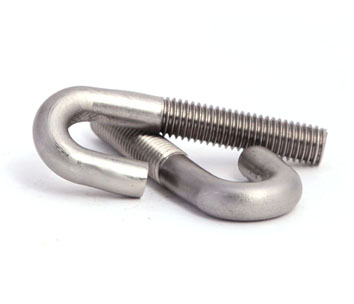
A J bolt is a round steel rod with a thread at one end and a J-shaped hook at the other. Cast into concrete, the hook keeps the rod from pulling out, and a nut on the projecting thread holds down a sill plate, a column base or a machine.
Exotic Alloy manufactures J bolts in Mumbai, India. Anchor bolts are made to ASTM F1554 from certified bar: threads are rolled or cut, the hook is bent on a former, and the bolts are hot-dip galvanized after bending when required. Each grade is marked with its F1554 colour. We supply contractors and distributors in India, and export to Canada, the USA, the Gulf and Africa.
Common ½″ × 10″ to ¾″ × 18″ sill-plate J bolts in Grade 36 galvanized ship from stock. Other lengths, hooks, grades and stainless J hook bolts are made to your drawing.
The range we manufacture and supply.
For anchoring wood sill plates to foundations under the residential code. They are supplied with a nut and washer and, where required, a square plate washer.
For light columns, poles, signs, equipment pads and tanks, made to the hook, thread and projection on your drawing.
A right-angle bend instead of a J. It is easier to tie into reinforcement and is treated by ACI 318 like a J bolt. See also anchor bolts.
Threaded J hooks with nut and washer for hanging pipes and cable trays, fixing roof sheets to purlins and securing loads, as in the product photo.
For projects specified in metric, made to drawing with metric threads, nuts and washers.
For marine structures, water treatment plants and food factories, where zinc is not acceptable.
| Feature | J bolt | L bolt | Headed anchor |
|---|---|---|---|
| End in concrete | 180° hook | 90° bend | Forged head, or nut and plate |
| ACI 318 pullout | 0.9 f′c eh da | 0.9 f′c eh da | 8 Abrg f′c (usually much higher) |
| Typical use | Sill plates, light equipment, J hooks | Light columns, poles, tie-in to rebar | Column bases, high tension, seismic |
| Cost | Low | Low | Higher |
J bolts have no fixed catalogue size: diameter, length, thread length and hook are chosen for the job. When ordering, give D, L, T and the hook, and we bend to that drawing within the F1554 tolerances below.
| Size | Hook eh min 3 da, in | Hook eh credited max 4.5 da, in | Pullout Np, 3,000 psi eh = 4.5 da, cracked, lbf | Steel Nsa, Gr 36 lbf | Steel Nsa, Gr 55 lbf | Np / Nsa Gr 36 |
|---|---|---|---|---|---|---|
| 1/2″ | 1.50 | 2.25 | 3,000 | 8,200 | 10,600 | 37 % |
| 5/8″ | 1.88 | 2.81 | 4,700 | 13,100 | 17,000 | 36 % |
| 3/4″ | 2.25 | 3.38 | 6,800 | 19,400 | 25,100 | 35 % |
| 7/8″ | 2.62 | 3.94 | 9,300 | 26,800 | 34,600 | 35 % |
| 1″ | 3.00 | 4.50 | 12,200 | 35,100 | 45,400 | 35 % |
| 1-1/8″ | 3.38 | 5.06 | 15,400 | 44,300 | 57,200 | 35 % |
| 1-1/4″ | 3.75 | 5.62 | 19,000 | 56,200 | 72,700 | 34 % |
| 1-1/2″ | 4.50 | 6.75 | 27,300 | 81,500 | 105,400 | 34 % |
Our calculation with the ACI 318 hooked-bolt equations (nominal values, cracked concrete, no strength reduction factors). Hooks shorter than 3 da are outside the ACI rule, and hook length beyond 4.5 da is not credited. The last column shows that pullout, not the steel, usually limits a J bolt.
| Feature | F1554 tolerance (bent bolts) |
|---|---|
| Length L | ±½″ up to 24″ long; ±1″ over 24″. Measured from the inside of the bend to the end of the thread |
| Hook length | ±10 % of the specified hook, or ±½″, whichever is greater |
| Bend angle | ±5° from the specified angle |
| Thread length T | +1″ / −0″ |
| Thread | UNC (8UN over 1″ when specified), class 1A or 2A |
F1554 is the US specification for anchor rods: straight, bent (J and L) or headed. It has three strength grades, each identified by a paint colour on the projecting end.
| Grade | Tensile strength ksi (MPa) | Yield min ksi (MPa) | Elongation in 2 in, % min | Reduction of area % min | Diameter in | End colour | Permanent mark (S3) | Nut ASTM A563 |
|---|---|---|---|---|---|---|---|---|
| Grade 36 | 58–80 (400–552) | 36 (248) | 23 | 40 | ½ to 4 | Blue | AB36 | Grade A hex (heavy hex over 1½″) |
| Grade 55 | 75–95 (517–655) | 55 (379) | 21 | 30 | ½ to 4 | Yellow | AB55 | Grade A hex / heavy hex |
| Grade 105 | 125–150 (862–1034) | 105 (724) | 15 | 45 | ½ to 3 | Red | AB105 | Grade DH heavy hex |
Grade 55 with supplementary requirement S1 has a carbon-equivalent limit so that it can be welded; it is marked yellow on the projecting end and white on the embedded end. Charpy impact testing (S4) is available for Grades 55 and 105.
| Size | Threads / in | Stress area in² | Gr 36 tensile min, lbf | Gr 36 yield min, lbf | Gr 55 tensile min, lbf | Gr 55 yield min, lbf | Gr 105 tensile min, lbf | Gr 105 yield min, lbf |
|---|---|---|---|---|---|---|---|---|
| 1/2″ | 13 | 0.1419 | 8,200 | 5,100 | 10,600 | 7,800 | 17,700 | 14,900 |
| 5/8″ | 11 | 0.2260 | 13,100 | 8,100 | 17,000 | 12,400 | 28,300 | 23,700 |
| 3/4″ | 10 | 0.3345 | 19,400 | 12,000 | 25,100 | 18,400 | 41,800 | 35,100 |
| 7/8″ | 9 | 0.4617 | 26,800 | 16,600 | 34,600 | 25,400 | 57,700 | 48,500 |
| 1″ | 8 | 0.6057 | 35,100 | 21,800 | 45,400 | 33,300 | 75,700 | 63,600 |
| 1-1/8″ | 7 | 0.7633 | 44,300 | 27,500 | 57,200 | 42,000 | 95,400 | 80,100 |
| 1-1/4″ | 7 | 0.9691 | 56,200 | 34,900 | 72,700 | 53,300 | 121,100 | 101,800 |
| 1-1/2″ | 6 | 1.4053 | 81,500 | 50,600 | 105,400 | 77,300 | 175,700 | 147,600 |
Our calculation: ASME B1.1 tensile stress area times the F1554 minimum tensile and yield strengths. It agrees with published F1554 load tables within rounding (under 0.5 %).
Compare the concrete pullout of the hook with the tensile strength of the rod. For a J or L bolt, ACI 318 gives Np = 0.9 f′c eh da, with 3 da ≤ eh ≤ 4.5 da. The steel strength is Nsa = Ase,N futa.
Nominal strengths only. Strength reduction factors, concrete breakout, side-face and edge effects, and load combinations are not included, so a qualified engineer must complete the anchor design.
J bolts are cast in when the concrete is placed, so they must be set accurately in a template before the pour.
| Finish | Specification | Notes |
|---|---|---|
| Plain (black) | – | For bolts fully encased and protected; the projecting end is painted with the structure |
| Hot-dip galvanized | ASTM A153 Class C / ASTM F2329 | Galvanized after bending; nuts over-tapped to ASTM A563 to suit the zinc |
| Partial galvanizing | Projecting end only | Where the embedded end must stay bare for bond with the concrete, by agreement |
| Passivated stainless | ASTM A967 / A380 | 304, 316 and duplex J bolts |
| Alloy | UNS | Condition supplied | Tensile min MPa | Yield 0.2 % min MPa | Elongation % | Why it is chosen for hex bolts |
|---|---|---|---|---|---|---|
| Inconel 625 | N06625 | Solution annealed (Grade 1) | 827 | 414 | 30 | Seawater, sour gas, cryogenic to 980 °C oxidation; subsea flange bolting |
| Inconel 718 | N07718 | Solution treated + aged (AMS 5662) | 1240 | 1035 | 12 | Highest strength to 650 °C; turbine and wellhead bolting |
| Monel 400 | N04400 | Hot-finished annealed | 517 | 207 | 35 | Seawater, hydrofluoric acid, no chloride SCC; marine and valve bolting |
| Monel K-500 | N05500 | Age hardened (AMS 4676) | 960 | 690 | 18 | Monel 400 corrosion resistance with three times the yield; pump shafts, subsea |
| Hastelloy C-276 | N10276 | Solution annealed (ASTM B574) | 690 | 283 | 40 | Wet chlorine, hot acids, mixed oxidising / reducing media; chemical reactors |
| Incoloy 825 | N08825 | Annealed (ASTM B425) | 586 | 241 | 30 | Sulphuric and phosphoric acid, sour gas (NACE MR0175); pickling plant |
| Duplex 2205 | S32205 | Solution annealed | 655 | 450 | 25 | Twice the yield of 316 with chloride SCC resistance; offshore topsides |
| Super Duplex 2507 | S32750 | Solution annealed | 750 | 550 | 15 | PREN > 40; seawater and desalination bolting |
| Titanium Grade 5 | R56400 | Annealed (ASTM B348) | 895 | 828 | 10 | Half the weight of steel, immune to seawater; aerospace and chemical |
| A-286 | S66286 | Solution treated + aged | — | — | — | Iron-base superalloy for 650 °C bolting; on request with certified values |
Bar minimums from the linked datasheets for the supply condition shown. Stainless and nickel alloy J bolts fall outside ASTM F1554 and are certified to the bar or an agreed fastener specification.
Round bar received by heat with mill certificates, checked against the grade chemistry and cut to developed length.
Threads rolled on reduced-diameter blanks or cut on full-diameter bar, to UNC 1A / 2A or metric 6g.
Hooks formed on a bending former to the drawing radius and hook length, then checked against the bend-angle and hook tolerances.
Grade 105 bar is quenched and tempered, and test specimens from the same heat-treatment lot confirm its properties.
Hot-dip galvanized after bending when ordered; projecting end painted in the grade colour.
Nuts and washers matched to grade and coating, bagged and bundled with each size.
Anchoring sill plates and wall plates to foundations and slabs.
Pole bases, sign structures and fence posts on concrete piers.
Holding down pumps, generators, HVAC units and small tanks.
Light columns and girts in sheds, canopies and farm buildings.
Stainless J hook bolts hanging pipes, conduits and cable trays.
J hook bolts fixing roof sheets and solar rails to steel purlins.
| Test | Method | Applied to |
|---|---|---|
| Chemistry | Mill certificate; PMI on stainless | Every heat |
| Tensile, yield, elongation, RA | ASTM F1554 / A370 on bar or machined specimens | Every heat and size range; every heat-treatment lot for Grade 105 |
| Charpy impact | F1554 S4 | Grades 55 and 105 on request |
| Dimensions | Length, hook, bend angle, thread length | Every lot, to F1554 tolerances |
| Thread | Ring gauges, after galvanizing for HDG bolts | Every lot |
| Coating | Magnetic thickness gauge | Every galvanized lot |
Tell us the diameter, length L, thread length T, hook, grade, finish, nuts and washers, and quantity, or attach your drawing in the email. We respond within 2 to 4 business hours.