DIN 580 Lifting Eye Bolts
DIN 580 · M6 – M64 · C15E / A2 / A4The metric lifting eye bolt, forged with eye and collar in one piece. It has ratings for vertical, 45° pair and 90° in-plane loads, and the same eye sizes across manufacturers.
Drop-forged lifting eye bolts to DIN 580 from M6 to M64 and inch shoulder eyebolts to ASME B18.15 / ASTM A489 from ¼″ to 2″. We make them in C15E steel, A2 and A4 stainless, and on request in duplex and nickel alloys. Every lot is proof load tested, and every eye bolt is traceable to its heat and test certificate.
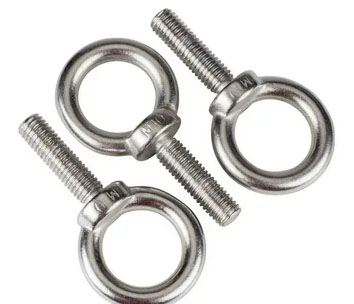
A lifting eye bolt screws into a tapped hole and gives a hook or shackle a safe place to lift. The eye and collar are forged in one piece. The collar seats on the surface and carries the side loads that would otherwise bend the thread.
Exotic Alloy manufactures lifting eye bolts in Mumbai, India. Metric eye bolts follow DIN 580, and inch shoulder and plain pattern eyebolts follow ASME B18.15 and ASTM A489. Every eye bolt is drop forged from certified bar, machined, threaded, and proof load tested in lots. We supply machine builders and rigging distributors across India, and export to Nigeria, Africa, the Gulf and Europe.
DIN 580 M8 to M36 in zinc-plated C15E and in A2 / A4 stainless ship from stock. Larger sizes, inch eyebolts, hot-dip galvanised finishes and exotic alloys are made to order.
The range we manufacture and supply.
The most important question is whether the eye bolt is for lifting. Only forged, rated eye bolts may carry a suspended load.
The metric lifting eye bolt, forged with eye and collar in one piece. It has ratings for vertical, 45° pair and 90° in-plane loads, and the same eye sizes across manufacturers.
The inch equivalent of DIN 580. The forged shoulder seats on the surface, so the eyebolt can take angled loads up to 45° at reduced capacity.
A straight shank with no shoulder, for in-line vertical lifting only, or through-bolted with a nut. Any angle bends the shank.
Forged stainless eye bolts for food plants, marine equipment, chemical plants and outdoor installations, proof tested to the same ratings as steel.
For tie-downs, guy wires, hinges and adjusting rods. They have no lifting rating and are marked and packed separately from lifting eye bolts.
DIN 580 geometry in corrosion-resistant alloys for offshore and chemical service. Their WLL is set by design and proof test and is stated on the certificate.
DIN 580 values as published in the 2018 edition tables and in manufacturers' DIN 580 data. Inch values are the ratings of forged shoulder pattern eyebolts proof tested to ASTM A489. The WLL marked on the eye bolt or stated on its certificate always governs.
| Size | Thread length l mm | Eye inside d4 mm | Eye outside d3 mm | Collar d2 mm | Height h mm | WLL 0° single, axial, kg | WLL 45° two-leg sling, kg | WLL 90° in eye plane, kg |
|---|---|---|---|---|---|---|---|---|
| M6 | 13 | 20 | 36 | 20 | 36 | 75 | 55 | 38 |
| M8 | 13 | 20 | 36 | 20 | 36 | 140 | 100 | 70 |
| M10 | 17 | 25 | 45 | 25 | 45 | 230 | 170 | 115 |
| M12 | 20.5 | 30 | 54 | 30 | 53 | 340 | 240 | 170 |
| M14 | 27 | 35 | 63 | 35 | – | 490 | 350 | 245 |
| M16 | 27 | 35 | 63 | 35 | 62 | 700 | 500 | 350 |
| M18 | 30 | 40 | 72 | 40 | – | 850 | 600 | 425 |
| M20 | 30 | 40 | 72 | 40 | 71 | 1,200 | 860 | 600 |
| M22 | 36 | 50 | 90 | 50 | – | 1,400 | 1,000 | 700 |
| M24 | 36 | 50 | 90 | 50 | 90 | 1,800 | 1,290 | 900 |
| M27 | 45 | 60 | 108 | 65 | – | 2,100 | 1,500 | 1,050 |
| M30 | 45 | 60 | 108 | 65 | 109 | 3,200 | 2,300 | 1,600 |
| M36 | 54 | 70 | 126 | 75 | 128 | 4,600 | 3,300 | 2,300 |
| M42 | 63 | 80 | 144 | 85 | – | 6,300 | 4,500 | 3,150 |
| M48 | 68 | 90 | 166 | 100 | – | 8,600 | 6,100 | 4,300 |
| M56 | 78 | 100 | 184 | 110 | – | 11,500 | 8,200 | 5,750 |
| M64 | 90 | 110 | 206 | 120 | – | 16,000 | 11,000 | 8,000 |
Dimensions in mm, WLL in kg. h is given for the sizes where it is published. The 45° value is the total load for two eye bolts with sling legs up to 45° from vertical, in the plane of the eye. Some catalogues state it per eye bolt or list slightly lower figures (for example 830 kg for M20), so we use the conservative total-load reading. The 90° value is for a single eye bolt pulled at right angles to its axis in the plane of the eye.
| Size | Threads / in UNC | Shank length in | Eye inside in | Eye outside in | Overall length in | WLL 0° lb (kg) | WLL at 45° 30 %, lb (kg) |
|---|---|---|---|---|---|---|---|
| 1/4″ | 20 | 1 | 3/4 | 1-3/16 | 2-3/8 | 650 (295) | 195 (88) |
| 5/16″ | 18 | 1-1/8 | 7/8 | 1-7/16 | 2-13/16 | 1,200 (544) | 360 (163) |
| 3/8″ | 16 | 1-1/4 | 1 | 1-11/16 | 3-9/32 | 1,550 (703) | 465 (211) |
| 7/16″ | 14 | 1-3/8 | 1-1/16 | 1-13/16 | 3-9/16 | 2,000 (907) | 600 (272) |
| 1/2″ | 13 | 1-1/2 | 1-3/16 | 2-1/8 | 3-31/32 | 2,600 (1,179) | 780 (354) |
| 9/16″ | 12 | 1-5/8 | 1-1/4 | 2-5/16 | 4-1/2 | 3,200 (1,451) | 960 (435) |
| 5/8″ | 11 | 1-3/4 | 1-3/8 | 2-9/16 | 4-3/4 | 5,200 (2,359) | 1,560 (708) |
| 3/4″ | 10 | 2 | 1-1/2 | 2-13/16 | 5-1/4 | 7,200 (3,266) | 2,160 (980) |
| 7/8″ | 9 | 2-1/4 | 1-11/16 | 3-3/16 | 5-31/32 | 10,600 (4,808) | 3,180 (1,442) |
| 1″ | 8 | 2-1/2 | 1-13/16 | 3-9/16 | 6-5/8 | 13,300 (6,033) | 3,990 (1,810) |
| 1-1/8″ | 7 | 2-3/4 | 2 | 4-1/16 | 7-21/32 | 17,000 (7,711) | 5,100 (2,313) |
| 1-1/4″ | 7 | 3 | 2-3/16 | 4-7/16 | 8-7/32 | 21,000 (9,525) | 6,300 (2,858) |
| 1-1/2″ | 6 | 3-1/2 | 2-1/2 | 5-3/16 | 9-15/32 | 24,000 (10,886) | 7,200 (3,266) |
| 1-3/4″ | 5 | 3-3/4 | 2-7/8 | 6 | 10-13/16 | 32,000 (14,515) | 9,600 (4,354) |
| 2″ | 4.5 | 4 | 3-3/8 | 6-7/8 | 11-7/8 | 40,000 (18,144) | 12,000 (5,443) |
Dimensions in inches. WLL is for a 0° vertical pull; the 45° column applies the 30 % factor for pulls of 31 to 45° from the bolt axis. Ratings for inch eyebolts differ between manufacturers, so always use the rating of the eyebolt actually supplied.
An eye bolt is strongest when pulled straight along its axis. Every degree of angle adds bending at the collar, so the allowed load falls quickly.
One eye bolt, straight vertical pull: load ≤ WLL at 0°.
A selection aid, not a lift plan. It assumes the load is shared equally between eye bolts, the eye is aligned with the sling leg, and each eye bolt is fully seated in a sound thread. Unequal leg lengths or an off-centre load put more on one eye bolt; a competent person must plan every lift.
The ratings only apply when the eye bolt is installed correctly. Most eye bolt failures start with a collar that was not seated.
A lifting eye bolt needs toughness more than hardness. Low-carbon forging steels and austenitic stainless steels give that toughness down to the bottom of the rated temperature range.
A low-carbon case-hardening steel to EN 10084 with excellent forgeability and toughness. It is the standard material for DIN 580 eye bolts, and is close to AISI 1015.
| Alloy | UNS | Condition supplied | Tensile min MPa | Yield 0.2 % min MPa | Elongation % | Why it is chosen for hex bolts |
|---|---|---|---|---|---|---|
| Inconel 625 | N06625 | Solution annealed (Grade 1) | 827 | 414 | 30 | Seawater, sour gas, cryogenic to 980 °C oxidation; subsea flange bolting |
| Inconel 718 | N07718 | Solution treated + aged (AMS 5662) | 1240 | 1035 | 12 | Highest strength to 650 °C; turbine and wellhead bolting |
| Monel 400 | N04400 | Hot-finished annealed | 517 | 207 | 35 | Seawater, hydrofluoric acid, no chloride SCC; marine and valve bolting |
| Monel K-500 | N05500 | Age hardened (AMS 4676) | 960 | 690 | 18 | Monel 400 corrosion resistance with three times the yield; pump shafts, subsea |
| Hastelloy C-276 | N10276 | Solution annealed (ASTM B574) | 690 | 283 | 40 | Wet chlorine, hot acids, mixed oxidising / reducing media; chemical reactors |
| Incoloy 825 | N08825 | Annealed (ASTM B425) | 586 | 241 | 30 | Sulphuric and phosphoric acid, sour gas (NACE MR0175); pickling plant |
| Duplex 2205 | S32205 | Solution annealed | 655 | 450 | 25 | Twice the yield of 316 with chloride SCC resistance; offshore topsides |
| Super Duplex 2507 | S32750 | Solution annealed | 750 | 550 | 15 | PREN > 40; seawater and desalination bolting |
| Titanium Grade 5 | R56400 | Annealed (ASTM B348) | 895 | 828 | 10 | Half the weight of steel, immune to seawater; aerospace and chemical |
| A-286 | S66286 | Solution treated + aged | — | — | — | Iron-base superalloy for 650 °C bolting; on request with certified values |
Bar minimums from the linked datasheets for the supply condition shown. An exotic alloy eye bolt is not covered by the DIN 580 load table: its WLL is calculated for the alloy, confirmed by proof load testing and stated on the certificate.
A lifting eye bolt is a safety part, so it is forged in one piece and tested before it ships.
C15E, stainless or alloy bar received by heat with mill certificates, cut to forging billets and marked for traceability.
Billets heated to forging temperature in an induction coil for uniform heat and minimal scale.
Eye, collar and shank are forged together in closed dies, so the grain follows the ring. The eye is never bent or welded.
Flash trimmed and the forging heat treated to the condition specified for the material.
Collar bearing face turned square to the axis, shank turned and the thread rolled or cut to 6g or UNC 2A.
Magnetic particle inspection of steel forgings, or dye penetrant on stainless, to the agreed sampling plan.
Proof load test per lot, finish applied, and each eye bolt marked with size, maker and batch.
| Finish | Specification | Corrosion | Notes |
|---|---|---|---|
| Zinc electroplate | ISO 4042 / ASTM F1941 | Indoor, moderate | The usual DIN 580 steel finish, blue or yellow passivated |
| Hot-dip galvanised | ISO 10684 / ASTM F2329 | Outdoor, long life | Thread made to suit the coating; for structures and outdoor equipment |
| Self-colour | Oiled | Temporary protection | For eye bolts that will be painted with the machine |
| Painted | To customer colour | Outdoor | Bright colours make lifting points easy to find on large equipment |
| Passivated | ASTM A967 / A380 | Full stainless resistance | Standard for A2 and A4 eye bolts |
Fitted lifting points on electric motors, gear units, pumps and compressors.
Handling injection moulds, press tools and heavy fixtures during set-up.
Lifting points on transformer tanks, panels and electrical enclosures.
A4, duplex and Monel eye bolts on deck equipment, hatches and skids.
Stainless eye bolts on mixers, tanks and covers that must be washed down.
Anchor points for guy wires and tie-downs, using non-lifting DIN 444 eye bolts where no lift is involved.
Take an eye bolt out of service if any of these checks fail. Never repair it.
| Check | Reject if |
|---|---|
| Marking | Size, maker or batch marking is missing or unreadable |
| Eye | Bent, twisted, stretched or out of plane with the shank; nicks or gouges on the ring |
| Collar / shoulder | Bearing face damaged, not square, or shows signs of having been loaded unseated |
| Thread | Damaged, worn or stretched thread, or a thread that will not run in by hand |
| Cracks & corrosion | Any crack; pitting or corrosion that reduces the section |
| Heat & modification | Weld spatter, heat discoloration, grinding or any modification |
| Tapped hole | Damaged, shallow or worn thread in the part being lifted |
| Test | Method | Applied to |
|---|---|---|
| Chemical analysis / PMI | Mill certificate; XRF PMI | Every heat; stainless and exotic alloy lots |
| Proof load | Static axial load above the WLL, then visual and dimensional check for deformation | Every lot |
| Breaking test | Load to failure on samples | Type and lot qualification |
| Crack testing | Magnetic particle (steel) or dye penetrant (stainless) | Agreed sampling; 100 % on request |
| Hardness | Brinell or Rockwell | Every heat-treatment lot |
| Dimensions & thread | Eye, collar, thread length; thread gauges | Every lot |
Tell us the standard, size, material, finish, quantity and the certificates you need. Our engineers respond within 2 to 4 business hours with pricing and lead time.