+91 97734 41022 sales@exoticalloy.com
Wedge anchors · A4 stainless · M6–M24

Anchor Bolts Manufacturer in India

Wedge anchor bolts for fixing steel, machinery and equipment to hardened concrete, from M6 to M24. Each comes with its nut and washer, in A4 (316) or A2 (304) stainless, zinc plated or hot-dip galvanized steel. We also make sleeve and drop-in anchors. This page shows how to drill, set and size them, with an EN 1992-4 capacity calculator.
Request a Quote WhatsApp Sales
  • ISO 9001:2015 certified manufacturer
  • Supplied with nut & washer
  • A4, A2, HDG & zinc plated
  • Custom lengths & threads
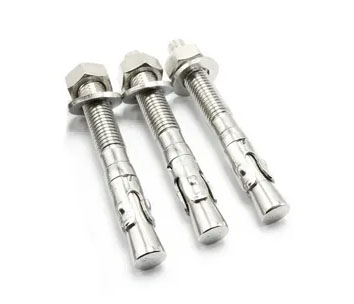
Three stainless steel wedge anchor bolts with hex nuts, washers and expansion clips
Size M6 – M24 Steel A4 · A2 · zinc Drill d0 = anchor size
Overview

Wedge & Expansion Anchor Bolts: Manufacturer & Exporter

An anchor bolt fixes steelwork, machines and equipment to concrete. The wedge anchor in the photo is the most common post-installed type. You drill a hole, push the anchor through the part being fixed, and tighten the nut. The cone pulls into the clip and locks the anchor in the hole.

Exotic Alloy manufactures anchor bolts in Mumbai, India. We supply contractors, fabricators, racking and solar installers and MEP firms across India, and export to Indonesia, the Gulf, Africa and Europe. Studs are cold formed with rolled threads. Clips are pressed from spring-tempered strip, and every anchor is packed with its nut and washer, ready to set.

Why a wedge anchor?

It goes in after the concrete has cured, through the fixture, with ordinary tools. It takes load as soon as it is torqued, with no curing time as with resin, and holds with a far stronger grip than a plastic plug.

M6 – M24 Through-fixing A4 / A2 stainless Zinc & HDG steel Sleeve & drop-in
Wedge anchor at a glance
Holds by
Expansion clip forced out by a cone
Drill bit
Same as anchor size (M12 → 12 mm)
Base
Hardened concrete, C20/25 to C50/60
Design
EN 1992-4 / ACI 318 Ch. 17 with ETA or ICC-ES data
Material
A4, A2 stainless; zinc plated, HDG steel
Related
J bolts (cast-in), U bolts, hex bolts
Parts of an M12 by 100 wedge anchor bolt: threaded stud with hex nut and washer at the top, plain shank, expansion clip around a reduced neck, and a cone at the tip that pulls into the clip and wedges it against the drilled hole hex nut ISO 4032 washer ISO 7089 rolled thread plain shank expansion clip cone (pulled into clip) L 100 (overall) d M12 EXOTIC ALLOY
Parts of an M12 × 100 wedge anchor, drawn to scale; clip and cone proportions vary between makes. The nut and washer come assembled. The clip is held loosely on the reduced neck until the nut is tightened.
Specification

Anchor Bolt Specification

The range we manufacture and supply.

ProductsWedge (through bolt) anchors; sleeve anchors; drop-in anchors; studs for chemical anchors; anchors to customer drawing
Size rangeM6, M8, M10, M12, M16, M20, M24; lengths to suit the embedment plus fixture thickness
ThreadMetric coarse, rolled, 6g; nut ISO 4032; washer ISO 7089 or large-diameter washer
MaterialsStainless A4 (1.4401 / 1.4404 / 1.4571), A2 (1.4301), HCR 1.4529; carbon steel
FinishPassivated stainless; zinc plated ≥ 5 µm (ISO 4042); hot-dip galvanized (ISO 10684)
Base materialNormal-weight concrete C20/25 to C50/60, cracked or non-cracked as allowed by the anchor’s assessment
Design & approvalDesign to EN 1992-4 or ACI 318 Chapter 17 using values from an ETA (EAD 330232) or ICC-ES report (AC193 / ACI 355.2)
MarkingSize, length code and material (e.g. A4) on the stud end; embedment mark on request
CertificationMill certificate; EN 10204 3.1 with material, dimensions and coating; PMI for stainless
PackingBoxes of 25 / 50 / 100 assembled anchors, bulk cartons, or private-label packs
Types

Types of Anchor Bolts

How each type holds in the concrete, and when to use it.

Five kinds of anchor bolt in concrete, in section: a wedge anchor with an expansion clip at the bottom of a drilled hole; a sleeve anchor with a split sleeve along its length; a drop-in anchor set flush in the concrete with a bolt screwed into it; a chemical anchor, a threaded rod bonded in resin; and a cast-in headed anchor bolt placed before the concrete is poured Wedge anchor torque-controlled Sleeve anchor light–medium duty Drop-in anchor flush, internal thread Chemical anchor rod bonded in resin Cast-in anchor bolt placed before pouring EXOTIC ALLOY
Five anchor types in section (schematic). The first three hold by expansion in a drilled hole, the chemical anchor by bond to resin, and the cast-in bolt by its head. See J bolts for cast-in hooked anchors.
TypeHow it holdsLoadCracked concreteTypical use
Wedge anchorCone expands a clip as the nut is torquedMedium to highOnly versions assessed for itSteel columns, racking, machinery, handrails
Sleeve anchorSplit sleeve expands along its lengthLight to mediumUsually non-cracked onlyFixtures in concrete and solid masonry
Drop-in anchorInternally threaded shell expanded with a setting toolLightMainly multiple-point, redundant fixingsPipe and cable tray hangers, threaded rod
Chemical anchorThreaded rod bonded in resinHigh, close to edgesWith systems assessed for itHeavy loads, small edge distances, rebar
Cast-in anchor boltHead or hook embedded during the pourHighestYesColumn base plates and foundations

Stainless Wedge Anchors

A4 (316) · A2 (304) · M6 – M24

Outdoor, coastal and wet locations: facades, balustrades, solar frames, marinas.

Zinc Plated & HDG Wedge Anchors

Carbon steel · ISO 4042 / ISO 10684

Warehouses, racking and dry interiors (zinc plated); mild outdoor exposure (galvanized).

Sleeve Anchors

Hex nut, hex bolt or countersunk head

Medium-duty fixing in concrete and solid brick, with hole tolerance taken up by the sleeve.

Drop-in Anchors

M6 – M20 internal thread

Flush with the soffit, ready for threaded rod hangers; supplied with setting tools.

Sizes

Wedge Anchor Sizes & Setting Data

SizeDrill bit d0
mm
Stress area As
mm²
Steel NRk,s 5.8
kN
Steel NRk,s 8.8
kN
Steel NRk,s A4-70
kN
Spanner
ISO 4032, mm
Washer
ISO 7089, mm
M6620.110.116.114.11012 × 1.6
M8836.618.329.325.61316 × 1.6
M10105829.046.440.61620 × 2
M121284.342.167.459.01824 × 2.5
M161615778.5125.6109.92430 × 3
M2020245122.5196.0171.53037 × 3
M2424353176.5282.4247.13644 × 4

Steel NRk,s = stress area × minimum tensile strength of the thread (our calculation); an anchor can fail at its neck first, so use the value in its ETA. The fixture hole is usually 1 to 2 mm larger than the anchor; the approval gives the maximum. Typical published installation torques for steel wedge anchors are 20 N·m (M8), 45 N·m (M10) and 60 N·m (M12); for other sizes follow the anchor’s approval.

Section through an installed M12 wedge anchor: a 12 mm hole drilled 90 mm deep, the anchor set 80 mm deep with an effective embedment of 70 mm, a 10 mm fixture, washer and nut on top; dashed lines show the concrete cone that would break out at a tension failure, reaching 1.5 times the embedment from the anchor at the surface Tinst hef 70 hnom 80 h0 90 tfix 10 d0 12 ccr,N = 1.5 hef concrete cone concrete C20/25 – C50/60 EXOTIC ALLOY
Installed M12 × 110 wedge anchor (section, schematic, 40 % scale). h0: hole depth; hnom: depth of the anchor below the surface; hef: effective embedment, which sets the concrete cone capacity; tfix: fixture thickness. The anchor length must cover hnom + tfix + washer + nut.
Installation

How to Install a Wedge Anchor

Four steps to set a wedge anchor: drill a hole of the anchor diameter to the required depth; clean the hole by blowing and brushing; hammer the anchor through the fixture until the washer sits on it; tighten the nut to the installation torque, which pulls the cone into the clip 1 2 3 4 d0 = d blow – brush – blow hammer through the fixture Tinst torque wrench to Tinst drill to depth h0 EXOTIC ALLOY
Four steps (schematic). Through-fixing means the hole is drilled through the positioned fixture, so the holes always line up.

Do

  • Drill with a hammer drill and a carbide bit of the anchor’s size
  • Clean the hole: blow, brush, blow
  • Keep to the minimum edge distance, spacing and member thickness of the approval
  • Apply the installation torque with a calibrated torque wrench

Don't

  • Set anchors in fresh concrete, or cut through reinforcement without approval
  • Use an oversize or worn drill bit: the clip cannot grip
  • Over-torque: it can split the concrete near edges
  • Use zinc plated anchors outdoors or in damp concrete
Design

Anchor Bolt Failure Modes & Concrete Capacity

An anchor in tension has four ways to fail. The design resistance is the lowest of them.

Four ways an anchor fails in tension: steel failure, where the bolt breaks; pull-out, where the anchor slides out of its hole; concrete cone failure, where a cone of concrete about three embedment depths wide breaks out; and splitting, where a crack runs from the anchor to a nearby edge edge top view Steel failure bolt breaks: NRk,s Pull-out anchor slides: from the ETA Concrete cone NRk,c, calculator below Splitting near edges, thin members EXOTIC ALLOY
Tension failure modes per EN 1992-4 (schematic). Steel and concrete cone resistance can be calculated. Pull-out and splitting depend on the anchor and are taken from its ETA or ICC-ES report.

Concrete cone resistance N0Rk,c of a single anchor

hef
mm
C20/25 cracked
kN
C20/25 uncracked
kN
C30/37 cracked
kN
C30/37 uncracked
kN
ccr,N = 1.5 hef
mm
scr,N = 3 hef
mm
408.712.410.715.260120
5012.217.414.921.375150
6016.022.919.628.090180
7020.228.824.735.3105210
8024.635.230.243.1120240
10034.449.242.260.2150300
12548.168.858.984.2187.5375

Characteristic values for one anchor away from edges and other anchors: N0Rk,c = k1 √fck hef1.5, with k1 = 7.7 (cracked) or 11.0 (non-cracked) for post-installed anchors (EN 1992-4; our calculation). Divide by γMc = 1.5 × γinst for design. ACI 318 uses the same √f′c hef1.5 form.

Calculator

Anchor Bolt Tension Capacity Calculator (EN 1992-4)

Single anchor in tension: concrete cone failure (including one edge) and steel failure. Use it for preliminary sizing, then check pull-out, splitting and minimum dimensions with the anchor’s ETA.

Anchor & concrete

Use cracked concrete unless the concrete is proven to stay uncracked. Embedment means the effective embedment hef. Take γinst from the anchor’s ETA. An edge distance of 1.5 hef or more means the edge has no effect.

Design tension resistance
15.0
kN NRd · concrete cone governs
Cone N0Rk,c:22.5 kN
Cone, design NRd,c:15.0 kN
Steel, design NRd,s:31.6 kN
Edge & spalling factors:1.00 × 1.00 × 1.00

Materials

Anchor Bolt Materials & Corrosion Protection

An anchor sits in concrete for the life of the building, so choose the material for the exposure.

MaterialGradeEN 1993-1-4 corrosion classTypical use
Carbon steel, zinc plated≥ 5 µm zinc (ISO 4042)—Dry indoor concrete only
Carbon steel, hot-dip galvanizedISO 10684—Outdoor in mild environments
Stainless A21.4301 (304)CRC IIIndoor and mild outdoor, no chlorides
Stainless A41.4401 / 1.4404 / 1.4571 (316 / 316L / 316Ti)CRC IIIOutdoor, coastal and industrial
High corrosion resistant (HCR)1.4529 (alloy 926)CRC VRoad tunnels, indoor swimming pools, offshore

Corrosion resistance classes (CRC) from EN 1993-1-4: the higher the class, the more aggressive the environment the steel can withstand.

Carbon steel
Zinc plated · HDG

Cold-heading steels for studs, spring strip for clips.

Stainless A2
1.4301 · CRC II

Indoor and mild outdoor use without chlorides.

Stainless A4
1.4401 / 1.4571 · CRC III

The usual choice outdoors, coastal and industrial.

HCR steel
1.4529 · CRC V

Road tunnels and indoor pools, where A4 can crack.

Manufacturing

How Our Anchor Bolts Are Made

1

Wire & strip

Stainless or carbon wire for studs; spring strip for clips; certified by heat.

2

Cold forming

Cone and reduced neck formed on multi-station headers.

3

Thread rolling

Metric threads rolled to 6g with the specified thread length.

4

Clip pressing

Clips stamped, rolled and fitted over the cone neck.

5

Finishing

Zinc plating, hot-dip galvanizing or stainless passivation.

6

Assembly

Nut and washer fitted, anchors gauged and boxed by lot.

Applications

Where Our Anchor Bolts Are Used

Steel structures

Column and beam brackets, mezzanines and canopies fixed to slabs and walls.

Racking & storage

Pallet racking base plates in warehouse floors.

Solar & facades

Rooftop solar frames, cladding brackets and balustrades in A4 stainless.

Machinery

Fixing machines, pumps and tanks to plinths and floors.

Infrastructure

Crash barriers, signs, rail fixings and tunnel services (HCR steel).

MEP services

Pipe supports, cable trays and duct hangers with drop-in anchors.

Quality & testing

Anchor Bolt Inspection & Site Testing

CheckMethodApplied to
Stud, cone & neckGauges and callipers to drawingEvery lot
ThreadRing gaugesEvery lot
Clip fitAssembly and slip check on the neckEvery lot
MaterialMill certificate; PMI for stainlessEvery heat
CoatingMagnetic thickness gaugePlated and galvanized lots
Tensile test in concretePull test on set anchorsOn request, per lot

Every shipment includes

  • Mill certificate with heat number
  • Dimensional and coating report
  • Lot number on every box

On site

  • Proof-load testing of installed anchors to BS 8539 can confirm installation quality
  • Installer records: hole depth, cleaning, torque
FAQ

Anchor Bolt Questions, Answered

A wedge anchor is a post-installed anchor bolt for concrete: a threaded stud with a cone at one end and an expansion clip around it, supplied with a nut and washer. It is pushed through the fixture into a drilled hole, and tightening the nut pulls the cone into the clip, which presses against the hole wall and locks the anchor in the concrete.

Use a drill bit of the same nominal diameter as the anchor: 10 mm for an M10 anchor, 12 mm for an M12 anchor, and so on. Drill deeper than the anchor's embedment so it can be set fully, and clean the dust out of the hole before installing.

Each anchor has its own approved values, but the concrete cone limit can be estimated with EN 1992-4. For example, an M12 anchor with 70 mm effective embedment in cracked C25/30 concrete, away from edges, has a characteristic cone resistance of about 22.5 kN and a design resistance of about 15.0 kN (partial factor 1.5). Pull-out and splitting values come from the anchor's ETA or ICC-ES report, and the lowest value governs.

A cast-in anchor bolt, such as a J bolt or headed bolt, is set in position before the concrete is poured and holds by its hook or head. A wedge anchor is installed later in a drilled hole in hardened concrete and holds by expansion. Wedge anchors let you fix items anywhere after the concrete has cured, without templates set during the pour.

Use the installation torque given in the anchor's approval or datasheet. Typical published values for steel wedge anchors are about 20 N·m for M8, 45 N·m for M10 and 60 N·m for M12. Too little torque leaves the clip unexpanded; too much can split thin members or close to edges.

Zinc plated anchors are for dry indoor concrete only. Use hot-dip galvanized or A4 (316) stainless anchors outdoors and in damp areas, A4 near the coast and in industrial air, and high corrosion resistant 1.4529 steel for road tunnels and indoor swimming pools.

The full concrete cone capacity needs an edge distance of 1.5 times the effective embedment and a spacing of 3 times the embedment (EN 1992-4). Anchors can be closer, down to the minimum values in their approval, but the capacity is reduced. Close to an edge there is also a risk of splitting.

Only wedge anchors assessed for cracked concrete, for example under an ETA option for cracked and non-cracked concrete or an ICC-ES report to ACI 355.2, should be used in tension zones of beams and slabs. Ordinary expansion anchors are for non-cracked concrete only. Cracked concrete also lowers the concrete cone capacity, as shown in the calculator.
Get Rapid Pricing & Availability

Request a Quote for Anchor Bolts

Tell us the anchor type, size, length, material, quantity and the fixture thickness. We respond within 2 to 4 business hours.

Inquiry Received!
Thank you. Our technical sales team will contact you shortly.