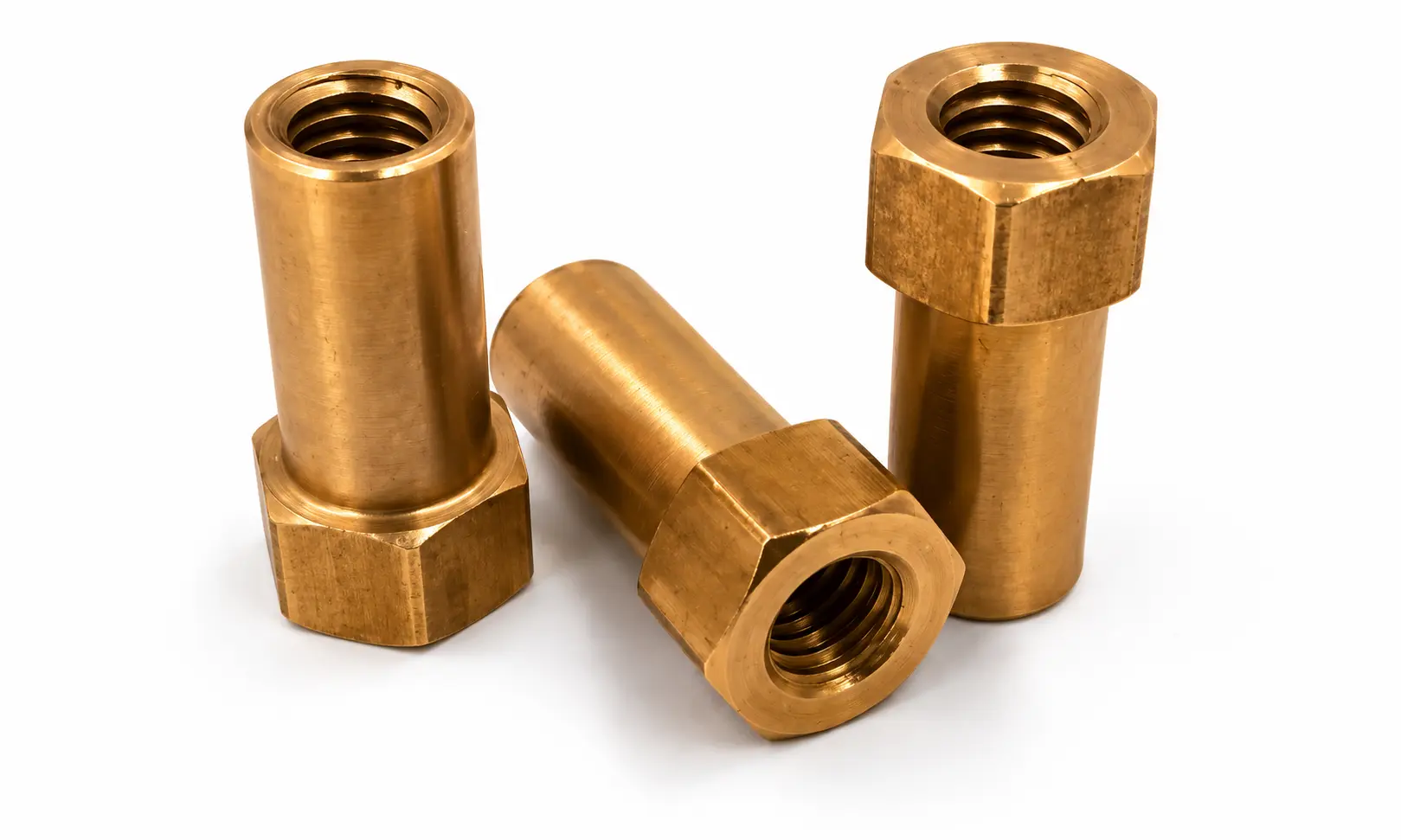
Lead restrictions. At 0.50–1.0% lead, C67600 is subject to drinking-water lead limits — the US Safe Drinking Water Act caps the weighted average of wetted surfaces at
0.25%, and the European Drinking Water Directive and national acceptance schemes apply equivalent controls — and to RoHS where the part is electrical or electronic. Given that CDA list gate valve stems among its typical uses, this is a live consideration rather than a theoretical one.
Confirm the regulatory position for your market before specifying C67600 for potable-water service, and consider unleaded
C67500 where the limit applies.
“Manganese bronze” is a misnomer, and CDA's own filing makes the point better than any argument could. Every alloy on this hub is a
copper-zinc alloy — which is to say a brass — with manganese, iron, aluminium and tin added for strength. Zinc runs from roughly 22% to 42%. There is no tin-bronze chemistry here at all; the tin that is present is a minor addition of 0.20–1.5%.
CDA then file the two halves of the family in
different classes. The wrought grades —
C67000, C67300, C67400,
C67500 and C67600 — are classed as
Wrought Bronzes, Other Copper-Zinc Alloys. The cast grades — C86100, C86200,
C86300, C86400 and C86500 — are classed as
Cast Brasses: Manganese Bronze and Leaded Manganese Bronze Alloy (High Strength Yellow Brasses). Same family, same chemistry, opposite designation.
Use the UNS number on drawings and purchase documents; the trade name is historical and the classification depends on which half of the family you are in.
What the name
does correctly signal is that these alloys behave nothing like an ordinary yellow brass. Manganese, iron and aluminium together lift tensile strength from a brass's typical 350–500 MPa to
414–758 MPa, add real wear and galling resistance, and make the alloys hot-forgeable to a degree few copper alloys match.
Read the aluminium column first — it splits this hub cleanly in two, and the two halves are used for quite different things.The low-aluminium group at 0.25–2.0% Al —
C67300,
C67400,
C67500,
C67600,
C86400 and
C86500 — runs 414–634 MPa, keeps 15–33% elongation, and includes every grade on this hub that machines acceptably. These are the valve stems, bushings, marine hardware and general-purpose castings.
The high-aluminium group at 3.0–7.5% Al —
C67000,
C86100,
C86200 and
C86300 — reaches 621–758 MPa at 180–223 HB, with 12–20% elongation and markedly worse machinability. These are the heavily loaded bearings, gears, screw-down nuts and bridge components. C86300 at 5.0–7.5% aluminium is the extreme:
758 MPa minimum and a machinability rating of 8, the lowest figure on this entire site.
Machinability is the single most variable property here, and it does not follow strength alone. The spread runs from 8 at C86300 through 26 at C86500 and 30 at C67400, C67500, C86100 and C86200, to
60 at C67600 and 65 at C86400 — the two deliberately leaded grades. If a manganese bronze part is machining-intensive, the lead content is what to look at, not the strength.
These are brasses with 22–42% zinc, and dezincification is the failure mode to design against. Zinc is selectively leached out of the alloy, leaving a porous, mechanically worthless copper residue that
retains the original shape and dimensions of the part. A dezincified valve stem or pump casing can look perfectly sound and fail under hand load. Susceptibility tracks structure: above roughly 37% zinc the alloy carries a zinc-rich beta phase that corrodes preferentially, and
C86400 at 34–42% and
C86500 at 36–42% sit squarely in that range.
None of these alloys is inhibited. Unlike
C44400 admiralty brass with its antimony addition or
C68700 aluminium brass with arsenic, no grade on this hub carries a dezincification inhibitor. The aluminium and manganese additions help — they contribute to a more protective surface film — and the high-aluminium grades do better than the low-aluminium ones, but help is not immunity.
Where a manganese bronze will see stagnant, warm or chlorinated water, confirm suitability for the specific service and expect to be asked to demonstrate it by ISO 6509 testing. For continuous seawater immersion, the
nickel aluminium bronzes are the usual step up.
The other classic brass failure applies too:
ammonia stress-corrosion cracking. Moist ammonia, ammonium compounds, amines and nitrites will crack a manganese bronze carrying high residual tensile stress. Stress relieve heavily cold-worked, swaged and tightly threaded parts, and note that CDA publish
HR02 stress-relieved tempers for C67400 precisely because of this.
How nine grades divide. Five are wrought and four are cast, and within each half the aluminium content sets the character.
Wrought. C67500 —
Manganese Bronze A — is the reference grade and the only one in
ASTM F468 as Cu 675: 448 MPa annealed to 579 MPa half hard, forgeability 80, eight listed specifications.
C67600 is the same alloy with 0.50–1.0% lead added, doubling machinability from 30 to
60.
C67000 —
Manganese Bronze B — jumps to 3.0–6.0% aluminium for forgings needing strength and wear resistance, though
CDA publish no mechanical data for it.
C67300 and
C67400 add
silicon at 0.50–1.5% with 2.0–3.5% manganese for anti-galling bushing and bearing duty against hardened steel; C67400 carries a
forgeability rating of 100.
Cast. C86500 is the general-purpose casting at 448 MPa minimum, and
C86400 is its leaded free-machining counterpart at
machinability 65, the best on this hub.
C86100 and
C86200 are the high-aluminium high-strength castings at 621–655 MPa and 180 HB, differing mainly in copper and zinc balance. Above them both sits
C86300 at
758 MPa minimum and 223 HB — documented on the
brass hub, where CDA's own classification places it.