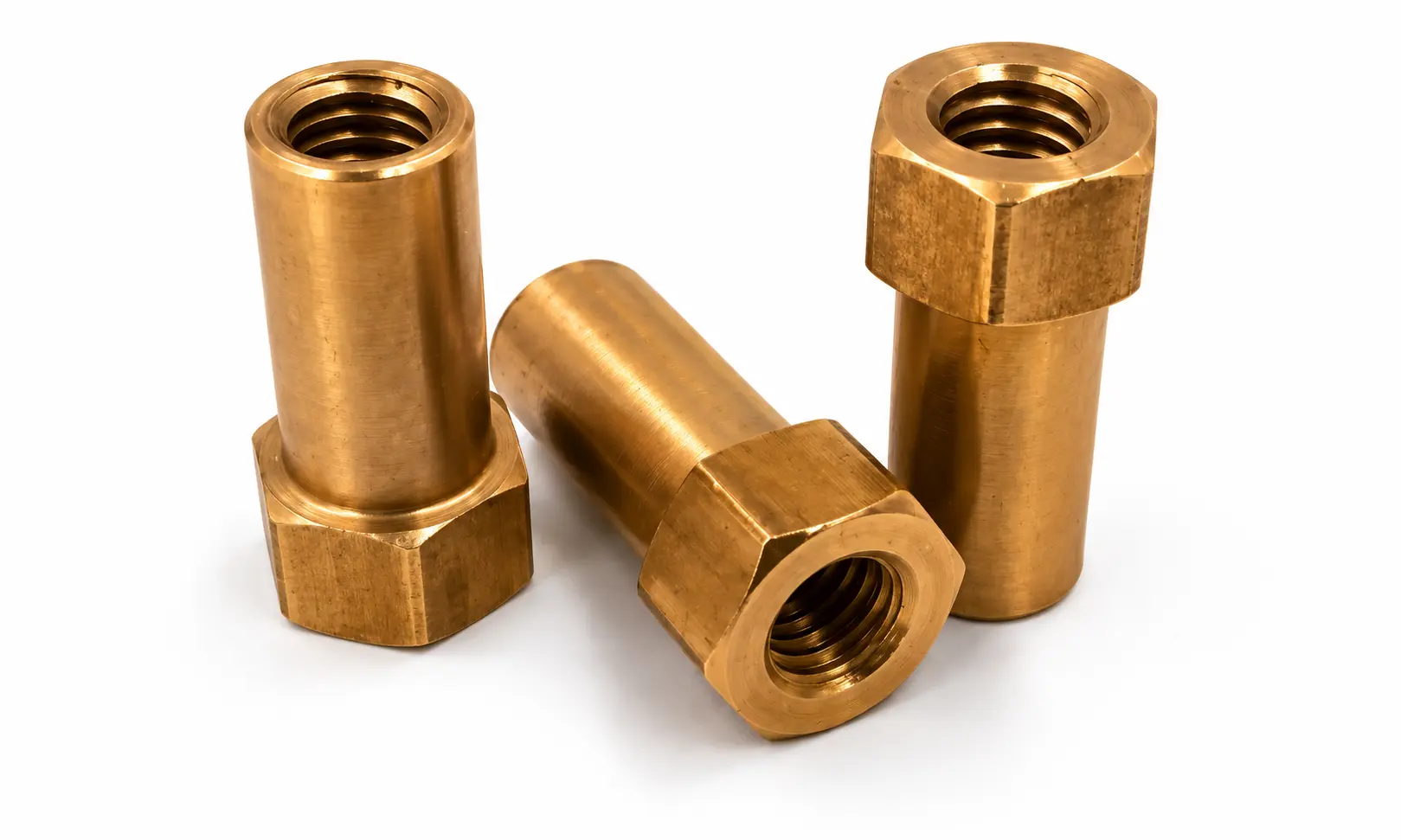
Lead restriction — C93500 carries 8.0–10.0% lead. The US Safe Drinking Water Act caps lead in drinking-water-contact components at a weighted average of
0.25% of wetted surfaces, with equivalent controls under the European Drinking Water Directive and national acceptance schemes, and RoHS restricts lead in electrical and electronic equipment. This alloy is
far above that limit. Traditional valve, pump and plumbing uses for leaded tin bronzes are now closed in most markets.
Confirm the regulatory position before specifying it for potable-water service, and consider the unleaded grades
C90500 or
C94700 where potable contact applies.
Casting alloy. Every grade on this hub is a cast alloy — supplied as sand, permanent mould, centrifugal and continuous castings and as cast bar for machining. None is available as rolled plate, drawn tube or extruded rod, and none appears in ASTM F468 or F467, which cover wrought fastener alloys. The casting method matters as much as the alloy: continuous cast material is routinely specified stronger than sand cast for the same grade, because directional solidification gives a denser, finer structure. State the casting method on the order.
Tin bronze is the original bronze — copper and tin, the alloy that gave an age its name — and on this hub the tin runs from 4.5% to 20%. Reading that range explains almost everything.Tin raises strength and hardness and then destroys ductility. C90200 at 6–8% tin gives 262 MPa at
30% elongation and 70 HB.
C91000 at 14–16% gives 221 MPa at
2% and 105 HB.
C91300 at 18–20% gives 241 MPa at
0.5% elongation and 170 HB. That is not a misprint: the highest-tin grades here are
hard and essentially brittle, with machinability falling to
10, the lowest CDA rating on this entire site. They are bearing, bell and wear materials, not structural ones.
The mechanism is the delta phase. Above roughly 8–10% tin the copper-tin system precipitates a hard intermetallic — conventionally
delta, Cu₃₁Sn₈ — dispersed through the softer alpha matrix. Delta is what gives a high-tin bronze its wear resistance, its hardness and its compressive strength, and it is equally what makes the alloy brittle and difficult to cut.
Choose the tin content against the duty: 5–8% for pressure-tight valve and steam castings that must take shock, 10–12% for loaded gears and worm wheels, 14% and above only where hardness and wear resistance outweigh everything else.
Copper-tin also has a
wide freezing range, which is a foundry matter rather than a service one but shows up in the product: these alloys are prone to interdendritic shrinkage and microporosity rather than concentrated piping, which is why tin bronzes are specified with pressure-tightness requirements and why the
zinc-bearing grades such as
C92200 exist — zinc deoxidises and improves fluidity and soundness.
Lead on this hub is not primarily a machining addition. It is a bearing material. That distinction matters, because it is why the lead contents here reach levels found nowhere else in copper metallurgy:
C94300 carries
23–27% lead, which is more than a quarter of the alloy by weight.
Lead is essentially insoluble in copper, so it sits as discrete soft globules throughout the casting. In a plain bearing those globules do four jobs at once. They act as a
solid lubricant if the oil film breaks down, giving the bearing a chance to survive momentary starvation. They provide
conformability, letting the bearing bed in to a slightly misaligned or out-of-round shaft. They give
embeddability, allowing dirt and swarf to be absorbed into the surface rather than scoring the journal. And incidentally they break the chip, which takes machinability from 20–30 in the unleaded grades up to
80.
The trade is strength and pressure tightness. Compare
C90500 at 0.30% lead and 276 MPa with C94300 at 23–27% lead and
165 MPa, or
C94100 at 18–22% lead and 172 MPa. The high-leaded grades are soft, weak and excellent at being bearings; they are not structural castings and should not be specified as such.
The regulatory position is the serious constraint on this family, and it is more acute here than on any other hub on this site. Lead in drinking-water-contact components is capped by the US Safe Drinking Water Act at a weighted average of
0.25% of wetted surfaces, with equivalent controls under the European Drinking Water Directive and national acceptance schemes, and RoHS restricts lead in electrical and electronic equipment. Many of these alloys are
traditional valve, pump and plumbing-fitting materials carrying 6–27% lead — twenty-five to a hundred times that limit.
A leaded tin bronze that was the obvious choice for a water fitting thirty years ago is now unusable in that application in most markets. Confirm the position for your market before committing a design, and consider the unleaded grades C90200 to C91300 or the nickel-tin bronzes where potable contact applies.
Twenty-four grades sort into four families, and the boundaries are set by lead and nickel rather than by tin.1. Straight tin bronzes — C90200 to C91300, lead 0.50% maximum. The classical gun metals and gear bronzes.
C90500, CDA's
Gun Metal, is the archetype at 9–11% tin. These are the pressure-tight, strong, relatively ductile grades at the low-tin end and the hard wear materials at the high-tin end. Machinability 10–30.
2. Leaded tin bronzes — C92200 to C92900, lead 0.30–6%. Enough lead for machinability and pressure tightness without losing structural strength.
C92200,
Navy M Bronze, is the classic steam and valve casting alloy, covered by ASTM B61. Machinability 40–70.
3. High-leaded tin bronzes — C93200 to C94300, lead 6–27%. The bearing bronzes.
C93200 is the universal bearing bronze and the most widely specified alloy on this hub;
C93700, CDA's
Bearing Bronze, is the high-duty version with twelve listed specifications. Machinability 70–80.
4. Nickel-tin bronzes — C94700 and C94800, nickel 4.5–6%. The outliers, and the most interesting metallurgy on the hub: these are the
only precipitation-hardenable alloys here.
C94700 goes from 310 MPa as cast to
517 MPa minimum heat treated, and carries an Izod of
85 ft-lb as cast — by a wide margin the toughest figure on this site.