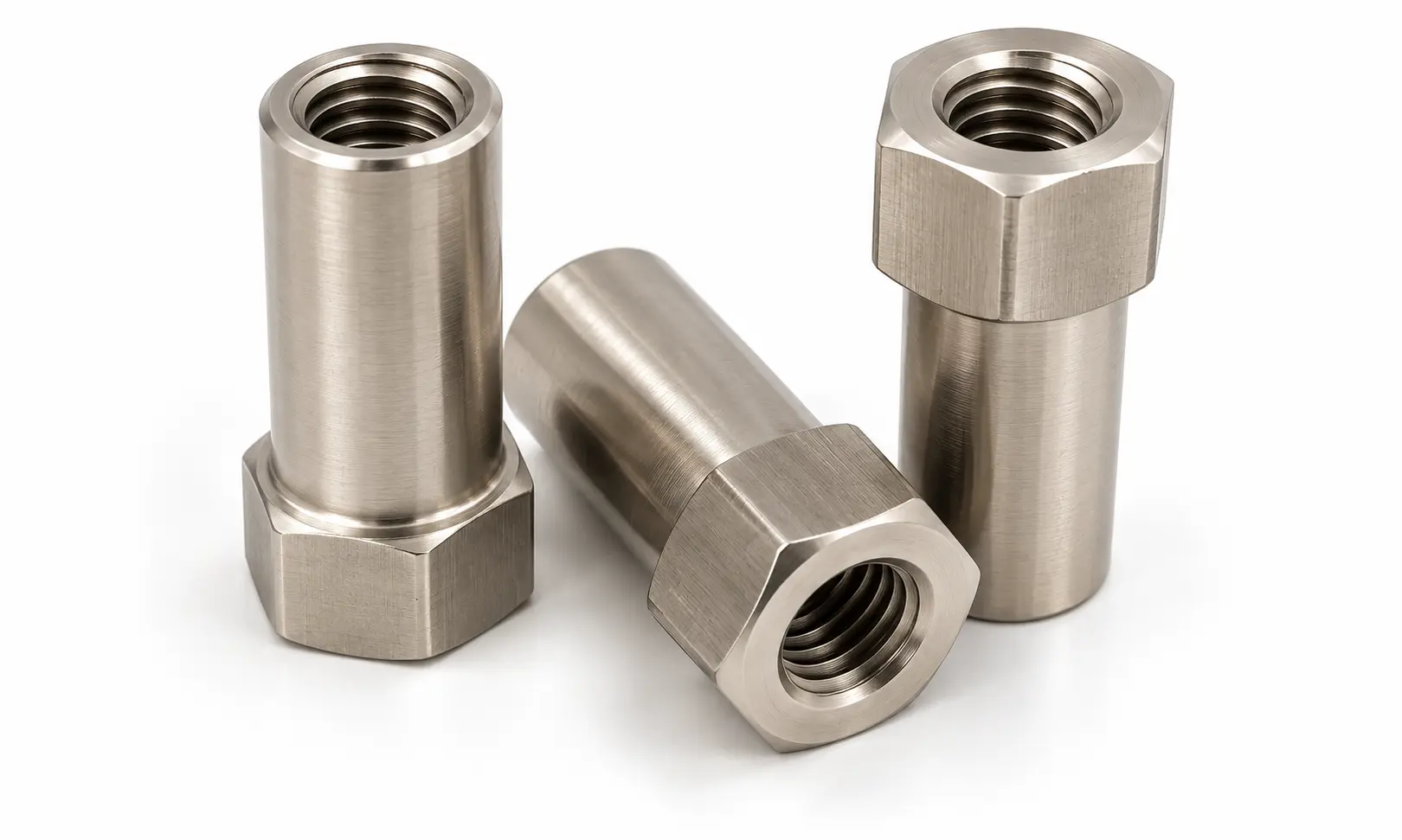
What distinguishes Alloy 52 within this family is not the magnitude of its expansion but the
flatness of it. The coefficient stays almost constant up to approximately 565°C, a wider span than any of the lower-nickel grades manage, which is what makes it suitable for seals that have to survive repeated thermal cycling over a broad range rather than sitting at a fixed temperature. Its low dispersion also makes it useful in high-frequency electronic applications. It is used for glass-to-metal sealing against the softer glasses and for some ceramic seals.
Alloy 52 is at the high-nickel end of the family, so its coefficient of roughly 10 µm/m·°C is around seven times that of Alloy 36 and sixteen times that of Alloy 32-5. Nobody specifies it for minimum movement — it is specified for the match and the flat span.
How to choose within the family: as nickel rises from 32% to 52%, two things happen together — the expansion coefficient rises, and the temperature range over which it stays constant extends. Alloy 32-5 gives 0.63 µm/m·°C but only from −55 to 95°C. Alloy 36 gives 1.4 µm/m·°C to about 260°C. Alloy 42 gives 5.3 to about 300°C. Alloy 48 gives 8.5 with a Curie point near 471°C, and Alloy 52 gives roughly 10 and holds it to about 565°C. You are not looking for the lowest number — you are looking for the alloy whose expansion matches the glass, ceramic or semiconductor it has to seal against, across the temperature range the joint will actually see.
Cold work and machining stress distort the expansion coefficient. This is the governing processing constraint for the whole family, and for Alloy 52 the published guidance is explicit that cold working is not recommended for exactly this reason. Machining, forming, drawing and thread rolling all introduce residual stress, and residual stress shifts the coefficient the part was bought for. Exotic Alloy therefore completes machining and threading first and performs the annealing or stabilising treatment on the finished component — a part worked after its final treatment no longer carries its certified expansion behaviour.
These alloys are not stainless. Chromium is capped at 0.25% as an incidental residual rather than added as an alloying element, so there is no passive film and the material rusts in damp air much like plain carbon steel. Nickel, tin or dry-film coating is required for exposed or humid service, and sealing-grade material is often supplied with a controlled surface oxide instead, because a thin adherent oxide is what the glass actually bonds to.
These are property alloys, not strength alloys. Room-temperature tensile strengths of 520 to 552 MPa with yields of 260 to 276 MPa put them around annealed 304 stainless and well below any structural bolting material. They are specified for dimensional and sealing behaviour, not for load.
The N alloys and the I alloys are the same family of materials under two trade names. Nilo is the Special Metals designation for the controlled-expansion iron-nickel alloys that other producers sell as Invar, Pernifer, Magnifer or SUPRA; the chemistry is defined by the UNS number and ASTM F30 or F1684, not by the brand. Alloy 36 and Alloy 42 in this family are UNS K93600 and UNS K94100 — exactly the same materials as the Alloy 36 and Alloy 42 pages listed under
I Alloys. Only Alloy 48 and Alloy 52 are chemistries that do not appear there.
Nilo is a trademark of the Special Metals Corporation group, Pernifer and Magnifer are VDM Metals trademarks, and Invar is a registered trademark originating with Imphy Alloys. Exotic Alloy is an independent manufacturer and is not affiliated with or endorsed by any of them; these designations are used solely to identify the alloy chemistry, which is defined by the UNS number and ASTM specification given above.